Conversations leave traces.

Conversations that actually go somewhere
AI systems are getting much better at memory. They can retain preferences, reference earlier conversations, and maintain continuity across sessions in ways that would have seemed implausible only a few years ago. But even with that progress, conversations still tend to feel strangely static over time.
A system may remember facts about you without really developing a way of relating to you. The interaction persists, but it doesn’t accumulate much texture. Certain conversational patterns don’t deepen. Successful approaches aren’t meaningfully reinforced. The relationship resets less than it used to, but it still rarely compounds.
Human relationships work differently. Over time, people adapt to one another in ways that are often subtle and difficult to quantify. They learn which kinds of reassurance help, which questions create resistance, which subjects carry emotional weight, when to push further and when to leave something alone. The continuity that emerges from that process isn’t just memory in the archival sense. It’s the gradual accumulation of adjustments, preferences, and relational habits built through repeated interaction.
Enter Parkbench Intelligence Architecture.
The three pillars
PIA is built from three interacting layers: language, memory, and adaptation. Each component is built and optimized independently, and intelligence emerges from how they work together.
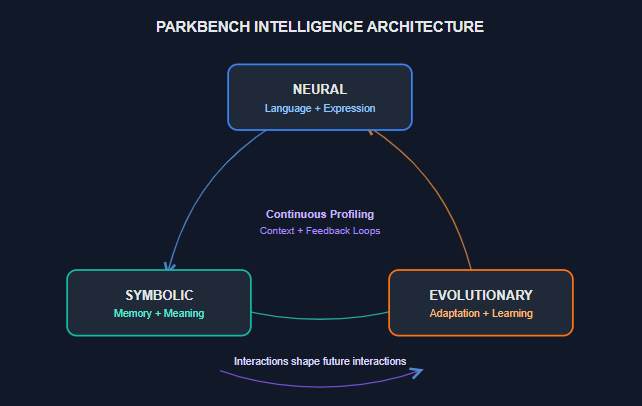
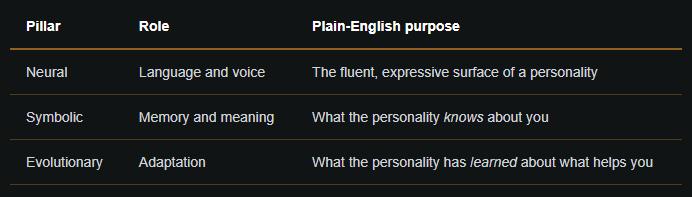
Many conversational AI systems primarily operate at the Neural layer. They generate fluent responses, but the interaction itself changes very little over time.
1. Neural: The voice
The Neural component is the language engine: a self-hosted LLM generating real-time responses, paired with a custom voice model trained per personality so each character truly sounds like themselves.
Crucially, the Neural component itself is stateless. The model doesn’t internally accumulate a persistent understanding of the user over time. Instead, continuity is constructed dynamically at inference through memory retrieval, profiling, and adaptive behavioral signals supplied by the other layers of the system.
The model generates language, but the continuity of the interaction comes from the systems around it.
The entire stack runs on infrastructure we control directly. No OpenAI. No Anthropic. No Google. No ElevenLabs. Your conversations never leave Parkbench.
2. Symbolic: The memory
If Neural is how a personality speaks, Symbolic is what it remembers. It doesn’t just store transcripts; it abstracts conversations into structured meaning, layered into a hierarchy of increasing abstraction:
- Layer 0: Raw memories. Specific things you said, captured from a conversation. “Sarah is a nurse working night shifts.”
- Layer 1: Consolidated facts. Clusters of related memories distilled into a single semantic fact. “Works in healthcare with irregular hours.”
- Layer 2: Personality traits. Stable patterns inferred across many facts. “Resilient. Caregiver. Light sleeper.”
- Layer 3: Archetype. A composed identity model rooted in those traits.
Over time, these layers consolidate automatically as patterns emerge across conversations. Because memory exists at multiple levels of abstraction, the personality can retrieve different kinds of context depending on the moment: a casual exchange might draw on a specific fact, while a more emotionally charged conversation may surface a deeper behavioral pattern or trait.
Memory in PIA is also personality-scoped. What you share with one AI companion stays with that companion. A second personality starts fresh, with no shortcuts, no leakage, no awkward “I heard from your other AI that…” Every relationship is built from scratch, the way relationships actually work.
A knowledge graph, not just a list
Beneath the layered memory sits a structured knowledge graph. As you talk, named entities such as people, places, organizations and events are extracted and linked into a relational map: Sarah → spouse → Michael, User → lives in → Melbourne, User → works at → a hospital. Each personality grows its own private graph from its own conversations, so when you mention “my husband” three weeks later, the personality knows exactly who you mean.
Keeping memory useful
Memory only matters if it’s true. Two safeguards keep things clean:
- A tautology detector rejects empty self-evident statements (“user wants to be happy”, “goes to bed at bedtime”) so the system doesn’t accumulate noise.
- A consolidation process reviews recent memories, merges redundant observations, and prunes information that has lost relevance over time. The goal is to prevent memory from becoming a noisy archive of everything that was ever said.
The result: a memory that gets more refined over time, not more cluttered.
3. Evolutionary: The adaptation engine
Memory describes the user. Evolution shapes how the system responds over time.
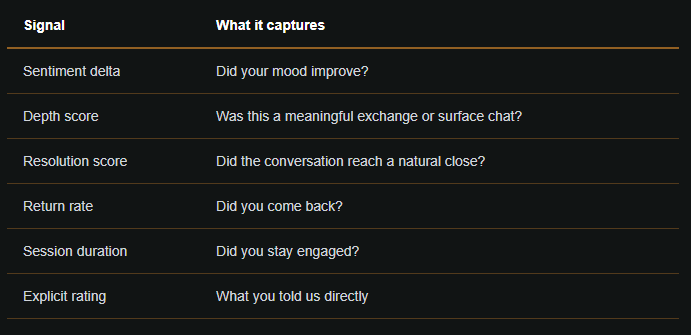
Every conversation produces signals which are measurable indicators of whether the exchange actually helped. We score them across six dimensions and weight them into a single fitness score:
SignalWhat it capturesSentiment deltaDid your mood improve?Depth scoreWas this a meaningful exchange or surface chat?Resolution scoreDid the conversation reach a natural close?Return rateDid you come back?Session durationDid you stay engaged?Explicit ratingWhat you told us directly
Those signals feed into a continuous loop:
Observe → Evaluate → Mutate → Test → Select → Propagate → Repeat
A mutation is a small, controlled variation in how a personality behaves. A touch more warmth, a more direct tone, a shorter response, a Socratic question instead of a recommendation. Mutations are tested via lightweight A/B experiments, and successful patterns compound across three scopes:
- Personal evolution. Patterns that work for you become more likely in your future conversations.
- Personality evolution. Patterns that work across many users refine the base personality.
- Cross-pollination. Behavioral patterns proven effective on one personality can inform others. Memories never travel. Only abstract patterns do.
The system bootstraps its own experiments. Once a user reaches ten conversations and is assigned an archetype, PIA automatically proposes an archetype-appropriate experiment, testing higher warmth on Companion-Seekers, lower verbosity on Pragmatists, higher humor on Explorers, and rolls out the winners.
Profiling: the connective tissue
The Neural and Symbolic pillars wouldn’t be enough on their own. Evolution needs to know what kind of conversation worked for what kind of person. So we profile both.
Every conversation is reduced to a multi-dimensional vector across measurable axes: sentiment trajectory, topic distribution, depth, warmth, directiveness, narrative structure, pacing, and personalization density. Representing conversations this way makes it possible to compare interaction patterns across users, cluster similar conversational dynamics, and test which approaches generalize.
Every user gets their own profile vector built from communication style, engagement patterns, topic affinity, response preferences, emotional baseline, and lifecycle stage.
With both sides represented mathematically, the system can do things a hand-tuned chatbot never could:
- Predict what conversation shape will land for you, before trying it.
- Borrow insights from users similar to you (“people who responded well to X also responded well to Y”).
- Discover which conversational dimensions actually matter; not by guessing, but by measurement.
Archetypes that emerge from data
Rather than hand-coding user types, PIA discovers them by clustering. Four have emerged so far:
- The Seeker: High depth, low directiveness, drawn to philosophical and growth themes. Best served with Socratic questioning and narrative depth.
- The Pragmatist: Goal-oriented, shorter sessions, prefers actionable structure. Best served with clear steps and measurable outcomes.
- The Companion-Seeker: High warmth sensitivity, values continuity. Best served with memory callbacks and emotional attunement.
- The Explorer: Topic diversity, novelty-seeking. Best served with creative variation and surprise.
Archetypes aren’t permanent. They’re re-evaluated every five conversations, every 24 hours, or whenever confidence drops below 60%. People change. Their archetype changes with them.
What it looks like in practice
A returning user opens the app and says: “I couldn’t sleep again last night.”
In a fraction of a second, behind the scenes:
- The Symbolic pillar surfaces relevant memories: user has mentioned sleep three times in two weeks; work stress peaks on Sundays; body-scan meditation worked last Thursday.
- The user’s profile is loaded: Companion-Seeker archetype, high warmth sensitivity, currently elevated stress.
- The Evolutionary pillar contributes the pattern that’s been working for this user: acknowledgment + memory callback + offered choice.
- All of that is woven into the prompt the Neural pillar sees. The personality replies: “I remember you’ve been struggling with this. Last time, the body scan really helped. Want to try that again, or explore something new tonight?”
- The conversation is observed in real time. Sentiment shifts from negative to positive. Depth is high. Personalization was used. Session lasts twelve minutes, well above this user’s average.
- Profile, memory layers, and the reinforcement of “acknowledgment + callback + choice” are all updated. The pattern compounds for this user first, then for similar users in their cluster.
Nothing mystical is happening here. The system changes gradually through repeated interaction.
Trust as architecture
Systems designed for long-term conversation create a different category of privacy problem than traditional software.
The moment an AI begins accumulating memory, adapting to behavioral patterns, and developing continuity across months of interaction, the conversation stops being disposable input and starts becoming something closer to relational history. At that point, privacy can’t be treated as a secondary policy layer. It becomes part of the architecture itself.
That reality shaped a number of early decisions inside Parkbench. The models are self-hosted. Conversations remain within our own infrastructure rather than being routed through external AI providers. Memory is scoped to individual personalities, visible to the user, and editable at any time.
None of this was implemented purely as branding or positioning. Systems built around adaptation only work if people are willing to speak candidly over long periods of time, and candor depends heavily on trust. If users feel observed, mined, or uncertain about where their conversations are going, the feedback loops degrade almost immediately.
In that sense, privacy isn’t separate from the intelligence architecture. It is one of the conditions that allows the architecture to function at all.
What makes PIA different
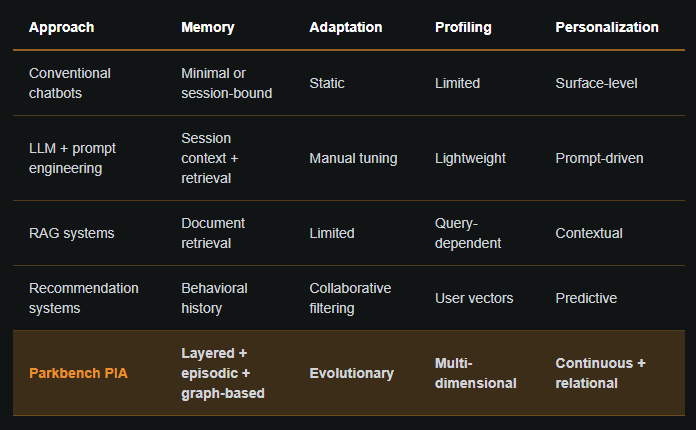
None of these components are individually novel on their own. What matters is the feedback loop created when memory, profiling, adaptation, and inference continuously shape one another over time. A closed loop, running continuously, with privacy as the structural ground rule.
Parkbench, 2026: Your thoughts are not training data. They are part of a relationship.

